LLC Tax DeadlineFor Texas owners
The federal day still follows the election. This page is the Texas report that sits beside it, and the sales-tax day when the company collected tax.
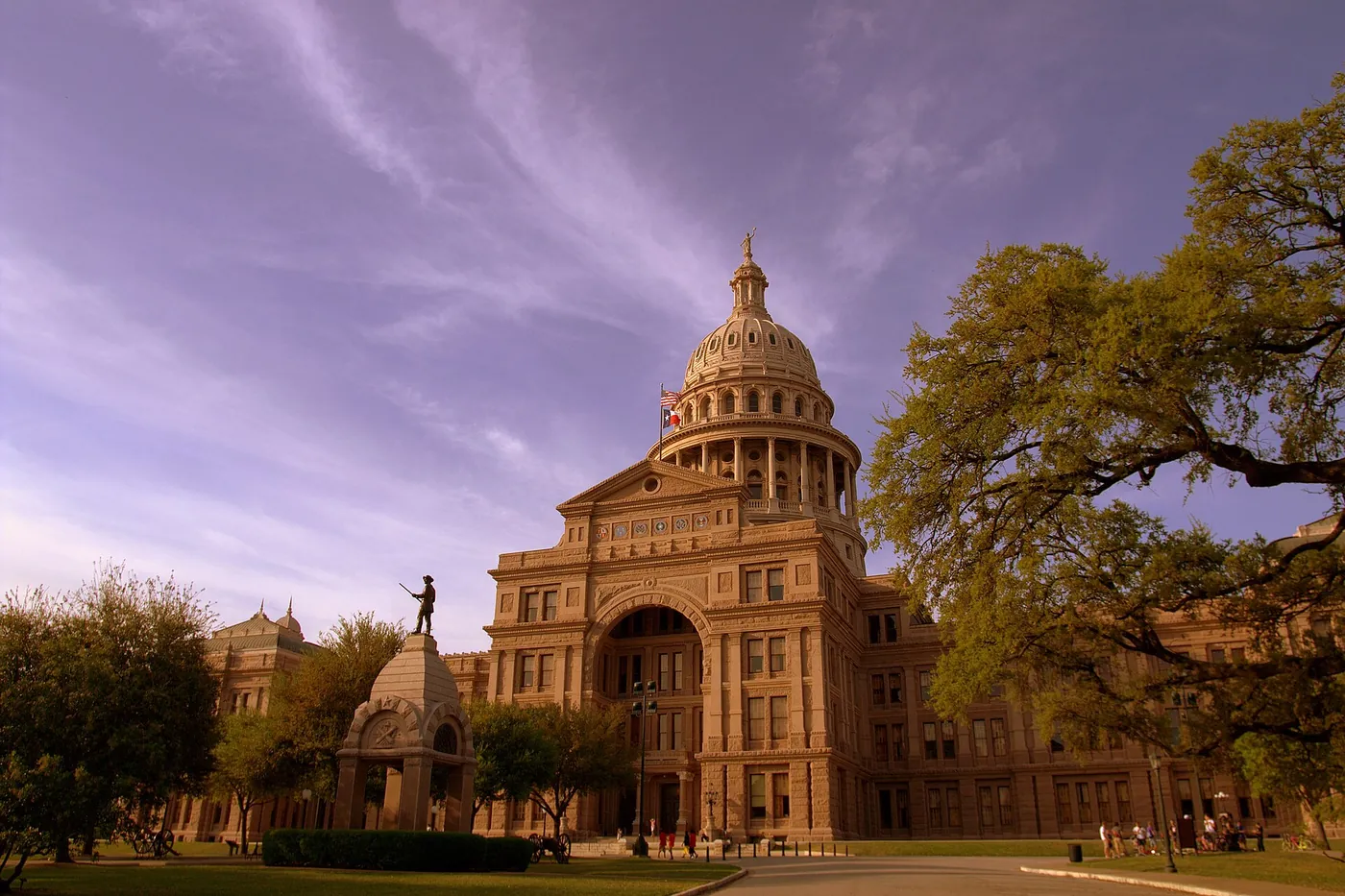
Photograph of the Texas State Capitol in Austin by Stuart Seeger, CC BY 2.0.
The election the agency already accepted is what places the federal filing day. A calendar-year partnership and a calendar-year S corporation gather in March. A disregarded owner and a calendar-year C corporation gather in April. An extension moves the filing and leaves the payment on the original day. Texas does not hand a limited liability company a different federal day. Texas adds its own report, and a sales-tax date when the company collected tax.
The practice is in Dallas. Owners anywhere else in Texas meet us on a video call, with the prior return and the acceptance letter on the screen if those exist. We do not keep a second office, and we do not ask anyone to drive in. Outside Dallas and Fort Worth the line is the one we use with every Texan who is not a neighbor. We are all Texans. The Friday on the calendar is the same Friday in the Rio Grande Valley, along the Gulf, and up in the Panhandle, and the books still close on the day we agreed, whichever county the shop sits in.
The Friday that belongs to two agencies
May 15, 2026 is a Friday. On the federal pages that Friday belongs to Form 990 for many calendar-year exempt organizations. It is the wrong hook for the income-tax return of a partnership, an S corporation, a disregarded owner, or a C corporation. The same Friday is the ordinary due date for the Texas franchise report, and for the public information report or the ownership information report that rides with it. Two agencies, two forms, one square on a wall calendar. A business company can owe the Comptroller that Friday and still have finished its federal return in March or April.
A company formed in Texas, or doing business in Texas, is generally the one that files. That includes a limited liability company with one owner, and a series company. Work done under a personal name, where no company was ever formed, sits outside this report in the ordinary case. A general partnership owned entirely by people, and not registered as a limited liability partnership, is in the group the Comptroller leaves off the list. We read the acceptance and the formation papers before we put the Friday on your calendar. A friend's note about April does not answer this question.
When the tax is zero and the short report is not
For reports due in 2026 and in 2027, a company whose annualized total revenue is at or under 2,650,000 dollars owes no franchise tax and does not file the tax report. It still files the short information report, Form 05-102 for a great many companies or Form 05-167 where the Comptroller points an entity to that form, unless the company is on the skip list. Leaving that short report unfiled can cost the company the right to sue or defend in a Texas court, and it can put officers, directors, partners, members, or owners on the hook for certain debts of the company. The tax can be zero and the information report can still be the filing that keeps the company able to do business.
The tax, in a year when there is tax, is computed on margin. Retailers and wholesalers use 0.375 percent. Other businesses use 0.75 percent. The compensation piece of that computation is capped at 480,000 dollars a person for these report years. When annualized total revenue for these report years stays at or under 20 million dollars, the company can take the EZ computation, and the rate on that path is 0.331 percent, with the margin deductions left behind. The longer computation picks one of four pictures of margin. Seventy percent of revenue. Revenue after the cost of goods sold. Revenue after compensation. Revenue after one million dollars. A shop that sells time rather than goods usually cannot fill the cost-of-goods picture, so that option is often closed before the meeting starts. The result is then shared out to Texas by gross receipts. Which of the four pictures we use waits for the revenue and the wages on the table. We choose it when the revenue and the wages are actually in front of us.
The twentieth, if tax was collected
Sales tax the company collected does not wait for the May franchise Friday. It has the 20th. April's collections, for a monthly filer, go out by May 20. Someone who files sales tax each quarter meets that same 20th after each quarter, so the meetings fall in April, in July, in October, and in the January that opens the next year. The state rate on the sale is 6.25 percent. Local pieces, whether a city, a county, or a transit district, can stack as much as 2 percent on that state rate, and once every local piece is included a single sale stops at 8.25 percent. This date column leaves the local percent off the writing. The sale's own location is what we read when the report is being prepared. Paying by the due day can keep half a percent of the tax as the on-time discount. Sending the report after the due day costs 50 dollars before the tax math even starts. The tax itself picks up 5 percent when the money arrives inside the first 30 days after the due day, and it picks up 10 percent when the money arrives after those 30 days. Beginning on day 61, interest is added at whatever percent the Comptroller has posted for that year, so this page names the day and leaves the percent where that office prints it.
A federal extension does not move any of this. Form 7004 and Form 4868 change a federal filing day. They leave the May franchise report where it is, and they leave the 20th where it is. The franchise extension is its own request. For 2026 the Comptroller chart prints May 15 for the report or the first extension request, August 17 for the next request that belongs to mandatory electronic payers, and November 16 for the report after an extension. A weekend or a holiday is why some of those printed days are not the 15th. Electronic transfer is how a franchise payment leaves once last year's bill to the Comptroller crossed 10,000 dollars. An entity that paid 500,000 dollars or more uses TEXNET, and that extension payment uses code 13080 rather than Form 05-164. The clock for that payment sits on the Comptroller's own page. We read the clock in the year of the filing.
The owner's own balance stays federal
Texas has no personal income tax. The state constitution bars one. The balance on the owner's own return is a federal balance. A letter from the Comptroller is about the company, the sales tax that was collected, or the franchise report. We still read the letter. The form number tells us which calendar it belongs to, the same way a federal notice tells us whether we are looking at March, April, or a payment that never moved.
On the call we still want the election that is on file and the date someone wrote on a note, and we add the Texas papers: the franchise report from the prior year when one exists, any letter the Comptroller already sent, and, where sales tax was collected, the rhythm the permit letter named. Closed months come before any number on those forms is worth trusting. A Friday with an open winter behind it is still just a Friday.